

In our previous article, we explored a fundamental shift occurring across the internet: the transition into a new golden age where traditional, static web templates are dying and the digital landscape belongs entirely to storytellers. We argued that true premium web design must look beyond basic execution, focusing instead on human strategy, visual character, and authentic narrative.
However, compelling storytelling is only one half of the modern equation.
While the front-end of your website must capture the hearts and minds of human visitors, the back-end must undergo an equally radical transformation. For decades, businesses have treated their websites like high-priced digital brochures. They are passive, static billboards sitting on a server, waiting for a human prospect to scroll through a few pages, fill out a standard contact form, and wait hours or days for a manual email response.
This model is a massive waste of leverage.
Your website should not be a digital brochure. It should be your most efficient, reliable, and active employee. The modern digital ecosystem allows us to look past the surface level of web design, transforming your online presence into an autonomous operational engine. By embedding intelligent logic layers directly into platforms like WordPress and Shopify, and connecting them to orchestrators like Airtable and Zapier, we can turn your website into a system that handles real business workflows entirely on its own.
1. The Integration Trap: Why Traditional Web Automation Left Businesses Brittle
To understand how modern technology elevates a website, we must first look at the limitations of traditional web automation. For years, the gold standard for connecting a website to business operations was a rigid, linear system built on simple logic loops: if this happens, then do that.
A user fills out a form on your WordPress site. In most cases, an email is sent with the submission details. In a slightly more advanced workflow, the site triggers a Webhook. An automation tool passes that raw data into a Google Sheet or a CRM. An internal team member gets an automated email notification telling them to read the sheet, review the lead, and manually take the next step.
While this style of integration was revolutionary ten years ago, it has become a major liability for growing brands. It is fundamentally brittle. It requires clean, predictable data to function. If a user misspells their email address, inputs data into the wrong form field, or submits an inquiry with complex, nuanced requests, the linear automation breaks down entirely. The data stalls, requiring human intervention to sort through the mess.
More importantly, traditional automation does not actually work for you; it merely passes information from point A to point B. It moves raw text around without understanding what that text means. It does not think, prioritize, or solve problems. Your team is still stuck performing the mental labor of evaluating every lead, sorting every support request, and managing inventory mismatches.
2. The Reasoning Layer: Supercharging Existing Stacks Right Now
We need to move past the cliché narrative that artificial intelligence is simply a magic wand that changes everything overnight. The real value is much more practical: the technology introduces a programmatic reasoning layer into systems you already use every day.
Instead of replacing your existing WordPress or Shopify website, we can use an intelligent framework to supercharge the connective tissues behind them. Platforms like Zapier and Airtable have evolved from basic data-storage utilities into powerful, context-aware orchestration hubs. They no longer just move data; they can comprehend it.
A modern automation setup allows a system to read ambiguous, unformatted user text, evaluate the underlying intent, cross-reference it with your live company records, and decide the optimal next step without a single line of custom, hard-coded logic. It can analyze the emotional tone of a customer inquiry, recognize whether an order issue requires immediate escalation, and autonomously draft a highly personalized solution based on a dynamic internal database.
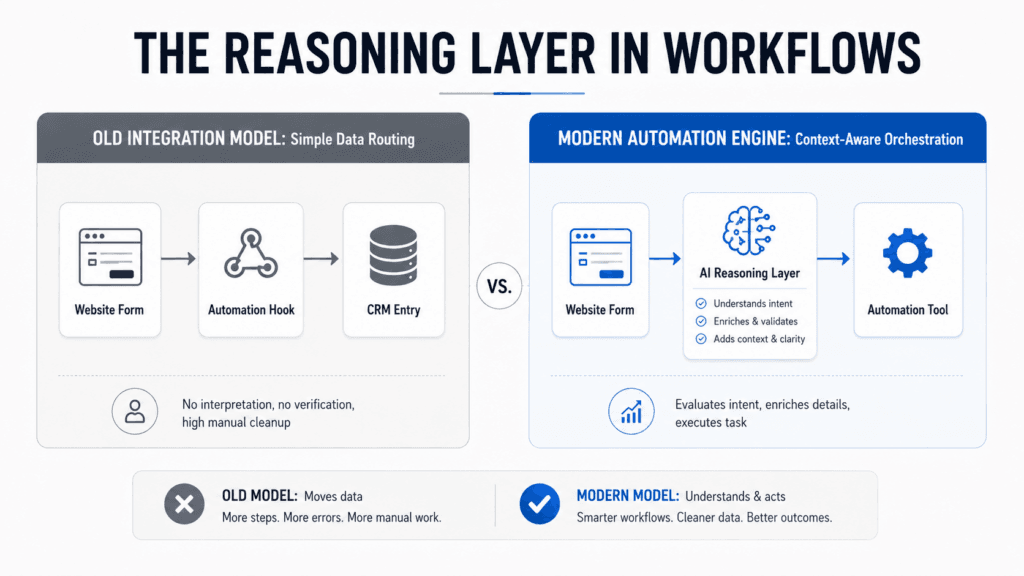
The website ceases to be a passive collector of text strings. It becomes an active gateway that processes, contextualizes, and acts upon human requests in real time.
3. The Core Architecture of an Active Digital Employee
When you transform your website into an operational engine, you are building an integrated ecosystem where your public-facing design acts as the interface, and your back-end tools act as the brain. Let us look at how this architecture functions across different core business needs.
Lead Triage and Autonomous Enrichment
In the traditional B2B model, a high-value prospect fills out a consultation form on a WordPress site and enters a queue. A sales representative eventually researches the company online, evaluates their funding status, checks if they match the ideal customer profile, and drafts a manual outreach email.
An active website removes this entire delay. The moment the form is submitted, the back-end system immediately takes over. Using tools like Airtable integrated with native model processing, the website can automatically look up the prospect’s company name across public databases, scrape their recent industry announcements, and identify their approximate revenue range.
The system then evaluates this enriched profile. If the lead matches high-value parameters, the operational engine uses an orchestration hub to dynamically score the profile, alert senior leadership via internal communication channels, and draft a customized contextual response referencing the prospect’s unique industry pain points. If the lead is a lower-tier match, it routes them into a tailored, automated educational sequence. Your team never spends time manually researching a lead or sorting through spam; they only step in when a fully qualified, context-rich opportunity is ready for a human conversation.
Predictive Operations and Conversational Commerce
For e-commerce brands utilizing Shopify, an active web setup moves far beyond standard transaction tracking. It links front-end buyer behavior directly with complex, real-time logistics.
Instead of relying on a human manager to monitor stock levels, calculate delivery delays, and update shipping alerts, a connected website uses an automated data layer to continually balance operations. If an unusual spike in regional sales threatens stock levels for a specific product line, the system does not wait for an inventory error to pop up at checkout. It can dynamically update the front-end product page messaging to reflect accurate local delivery windows, flag manufacturing partners for a reorder request within an Airtable base, and shift ad spend allocation automatically to highlight products with high stock availability.
When a customer interacts with a modern, context-aware support interface on the storefront, the engine does not just regurgitate a static list of frequently asked questions. It pulls the user’s specific order history, matches their current query against active freight data, and resolves complex shipping discrepancies directly, executing returns or generating custom store credits on the spot.
4. Designing Workflows: The New Frontier for Premium Web Agencies
This operational evolution completely redefines what businesses should expect when partnering with a premium web design agency. A high-end project can no longer stop at high-fidelity mockups, beautiful color palettes, and clean layouts.
The modern design process must balance front-end user experience with back-end workflow architecture. At Crushing Cones, we believe that an agency’s role is to design the entire digital ecosystem. This means mapping out data flows, identifying operational friction points, and structuring the hidden logic layers that keep a business moving forward.
| Operational Layer | Primary Function | Business Impact |
| Front-End Interface | Houses brand storytelling, captures user intent, handles interaction design. | Maximizes visual credibility, drives engagement, captures clean input data. |
| Relational Database | Acts as the operational single source of truth, manages dynamic company logic. | Eliminates scattered data silos, keeps business records instantly accessible. |
| Orchestration Hub | Connects disparate applications, routes tasks based on contextual reasoning. | Reclaims thousands of manual hours, removes administrative bottlenecking. |
When an agency builds with this holistic approach, your business receives a unified, self-sustaining ecosystem. We construct the public interface to captivate your audience, while building the background infrastructure to optimize your daily operations. You do not just launch a marketing asset; you deploy a scalable infrastructure that drastically cuts down on administrative tasks, reduces operational overhead, and ensures your company handles every single user touchpoint perfectly.
5. Reclaiming the Human Competitive Advantage
It is incredibly easy to get caught up in the technical mechanics of building an active web engine, but the ultimate goal of back-end automation is deeply human. By allowing intelligent tools to handle repetitive digital chores, data orchestration, and administrative triage, you are not removing the human element from your company. You are protecting it.
When your website actively qualifies leads, manages inventory alerts, updates tracking systems, and resolves initial support requests, your team is freed from the mind-numbing burden of manual data entry. They are no longer stuck inside a machine of repetitive tasks.
Instead, your employees can step into roles where human creativity and emotional intelligence are truly irreplaceable. They can spend their energy building genuine, high-touch relationships with your top-tier clients, developing innovative product lines, crafting disruptive marketing strategies, and focusing entirely on high-level business growth.
The real competitive advantage of a modern website does not come from removing human beings from the loop. It comes from building a highly intelligent, automated infrastructure that carries the operational weight, giving your team the space to do what humans do best: innovate, connect, and lead your brand into its next chapter.
To see how these technical automation architectures are shifting from simple linear integrations toward full-scale operational ecosystems that small, check out this discussion on how background infrastructure tools are evolving into agentic hubs. This conversation provides an excellent technical look at how async software design accidentally prepared the web development world for this highly productive, automated era.