
If you are running a business, managing a brand, or steering a B2B enterprise, you have likely been bombarded with the same tired prediction: AI is going to replace web designers. You have probably seen the software demos where someone types a single sentence into a prompt box, and thirty seconds later, a generic landing page pops out.
Most of those pages look terrible. They feel sterile, they lack soul, and they look exactly like every other generic layout cluttering the modern internet.
Because of this crude first wave of tools, it is incredibly easy for experienced builders and premium brands to dismiss the AI wave as overhyped noise. Many believe that AI cannot understand brand nuance, nor can it write custom business logic.
That perspective is comfortable, but it is dangerously wrong.
The disruption heading toward the web design industry is not about automated layout tools or rapid wireframing. It is much more profound. We are witnessing the collapse of the traditional, static infrastructure of the web itself. The way websites are planned, engineered, consumed, and maintained is undergoing a permanent architectural shift.
The agencies and brands that cling to the old model, treating a website as a rigid, hard-coded digital brochure, will look like relics within a few short years. Here is exactly how the landscape is breaking apart, and what the high-end digital experiences of tomorrow will actually look like.
1. The Death of the Static Template (The Era of Generative UI)
For decades, the fundamental workflow of web design has remained unchanged. You design a layout, you code the layout into a framework (whether that is a custom WordPress stack, a Shopify theme, or a headless React setup), and then every single user who clicks that URL sees the exact same arrangement of elements. We use media queries to shift layouts from desktop to mobile, but the blueprint remains completely rigid.
AI is entirely dismantling this concept through Generative UI.
In the very near future, websites will no longer be pre-rendered blocks of code waiting on a server. Instead, a website will exist as a fluid library of brand assets, data endpoints, and stylistic rules. The actual interface will not assemble itself until the exact millisecond a user requests the page.
Imagine a user landing on a B2B platform. The browser parses who the user is, where they came from, and what problem they are trying to solve. If the visitor is a deeply analytical Chief Technology Officer looking for technical specifications, the AI engine renders a data-dense, minimalist layout featuring interactive documentation and API code snippets. If a creative director clicks that exact same link five minutes later, the system detects their focus and instantly assembles a highly visual, narrative-driven interface showcasing motion design and case studies.
The template is dead. The website of tomorrow is an unpredictable, shapeshifting organism that customizes its own DOM structure on the fly to meet the immediate psychology of the visitor.
2. The Democratization of the "Award-Winning" Feel
Look at any website that wins industry design accolades. They all share specific traits: fluid motion paths, complex micro-interactions, physics-based animations, and contextual typography shifts that react smoothly to user behavior. Historically, these experiences were locked behind a massive financial barrier. Achieving that level of fidelity required a six-figure budget and a team of specialized creative engineers spending weeks writing custom WebGL or advanced JavaScript libraries.
AI is erasing that barrier, completely democratizing the high-end, premium aesthetic.
When an engineering engine handles the math behind intricate transitions, complex scroll-driven layouts, and stateful interactions, the technical execution becomes instant. A boutique brand or a growing B2B company will no longer be forced to settle for a boxy, uninspiring layout because they lack a massive development budget.
Every website will have the capability to feel incredibly high-end, interactive, and deeply immersive. The baseline standard for what qualifies as a good website is skyrocketing. If your site does not feel fluid, responsive, and alive, it will feel completely broken to a consumer accustomed to intelligent, motion-rich interfaces.
3. From Pixel Pushers to Design Directors
If you look at the day-to-day workflow of a traditional web designer, an embarrassing amount of time is spent on digital chores. They are alignment-checking grids, debugging minor cross-browser layout shifts, dealing with CSS padding discrepancies, and ensuring images compress correctly without losing clarity.
AI handles these mechanical, repetitive tasks instantly and flawlessly.
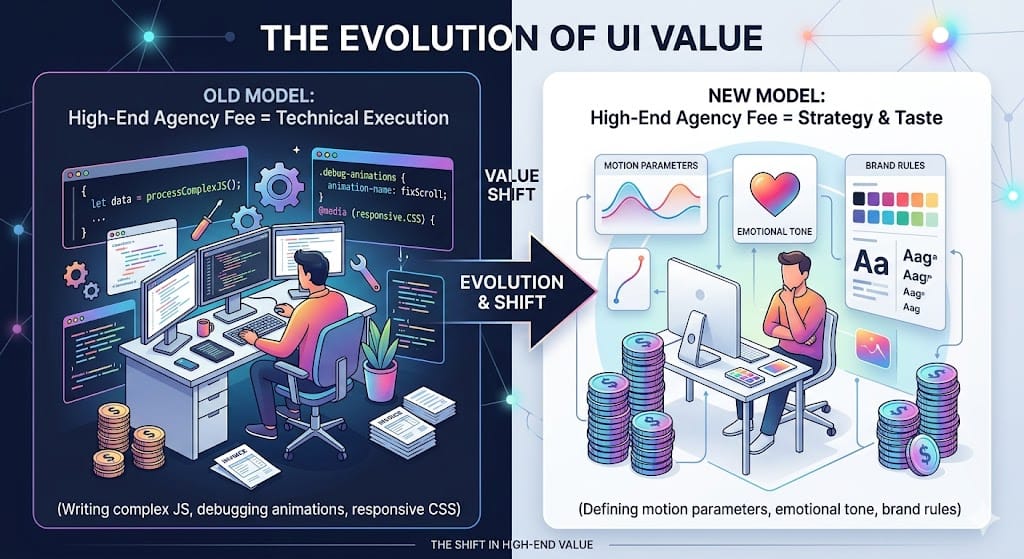
This shifts the role of the modern web agency entirely away from execution and drops it squarely into the realm of deep business strategy, user psychology, and brand architecture.
We are moving out of the era of pixel pushing and into the era of the human agency as the Design Director. The premium agency’s job is no longer to manually build the columns or fix the responsiveness. Instead, the agency’s job is to define the strict semantic boundaries, the emotional identity, the conversion funnel, and the aesthetic guardrails that the AI uses to generate the output.
Agencies will be valued for their taste, their strategic thinking, and their understanding of human behavior, rather than their ability to fiddle with code or manipulate vector layers for hours on end.
4. Hyper-Personalization Beyond the Superficial
Right now, when a marketer talks about a personalized website, they usually mean something incredibly surface-level. Maybe the homepage swaps out a headline based on a corporate IP address, or perhaps it pulls in a customer’s first name using a simple merge tag. It is an illusion of personalization built on rigid, pre-defined rules.
True AI-driven personalization is entirely contextual and fluid. It does not just change a line of text; it changes the architecture of the journey based on real-world variables.
- Contextual Comprehension: If a prospect opens a SaaS website at 11:30 PM on a mobile device while riding in a vehicle, the system recognizes the high-friction, low-attention environment. It strips away heavy background visuals, condenses long-form case studies into sharp bullet points, and surfaces a prominent action to text the link to their email.
- The Zero-Friction Flow: If that same user opens the site at 9:00 AM on a multi-monitor desktop setup, the layout reconfigures to present an expansive, high-intent interactive software demo.
Websites will stop forcing users to hunt through bloated, multi-tiered navigation systems to find what they want. The interface will intuitively predict the user’s intent based on subtle browsing indicators, actively moving content toward them and eliminating the traditional friction of clicking through a maze of links.
5. Designing for Two Separate Audiences: Humans and AI Agents
For twenty-five years, web design has been bound to the rules of Search Engine Optimization (SEO). We structured pages, managed heading hierarchies, and adjusted metadata so that Google’s crawling bots could index our pages and rank them on a results page.
We are rapidly moving out of the SEO era and into the realm of Generative Engine Optimization (GEO) or AI Optimization (AIO). We are no longer designing websites solely for human eyes and traditional search bots, because we are now designing them for autonomous AI agents.

Consider how corporate purchasing is changing. Instead of a procurement team spending hours browsing five different vendor websites, reading whitepapers, and filling out contact forms, an executive will simply task their internal AI agent with a directive: “Find the top three B2B web hosting providers that offer automated security compliance in Ontario, compare their pricing tiers against our current traffic, and generate a vulnerability report.”
The AI agent will crawl the web to find this data. If your agency or business website is built on old architectural principles, meaning your data is trapped behind unstructured layouts, vague copy, or clunky forms, the AI agent will ignore you. Websites must become hyper-structured, fast, and intensely transparent to machine reading. If a Large Language Model cannot instantly parse, verify, and ingest your company’s core value proposition and pricing logic, your business effectively ceases to exist to a massive segment of the market.
6. The Rise of Self-Healing, Autonomous Ecosystems
The traditional relationship between a client and a web agency usually involves an ongoing monthly maintenance retainer. This retainer exists because websites are fragile. A plugin update breaks a checkout flow, a third-party API changes its documentation and snaps a booking form, or a server update introduces a critical layout shift. Someone has to monitor the site, catch the error, and write the patch.
AI transforms websites from brittle, static code structures into living, self-healing digital ecosystems.
Tomorrow’s web platforms will execute continuous, autonomous quality assurance. The site will constantly run its own background browser simulations, testing every conceivable checkout path, contact form, and link structure. If an external API update breaks an integration, the site’s automated layer will isolate the bug, write a code patch, test it in a staging container, and deploy the fix to production within minutes. It will then send an administrative note to the agency and the business owner after the issue has already been resolved.
Furthermore, this continuous tracking extends directly to conversion rate optimization. Instead of waiting quarterly for an agency to look at analytics data and run a single A/B test, the platform will continuously test thousands of micro-variations. It will subtly adjust button positioning, swap asset colors, and refine call-to-action phrasing in real time based on statistical data, constantly tuning its own code to chase maximum performance without human intervention.
7. The Commoditization of Code and the Resurgence of the Human Premium
This brings us to the core truth of where this disruption leads. When anyone can use an AI prompt to create a perfectly functional, completely responsive, high-fidelity website in seconds, the value of functional code drops to absolute zero.
We are going to see an unprecedented explosion of digital noise. The internet will be flooded with an endless, overwhelming sea of AI-generated junk, which includes highly optimized, visually clean, but totally hollow websites that all sound and feel remarkably similar because they are drawing from the same global datasets.
When perfection becomes cheap, commoditized, and automated, it loses its power to captivate.
This is exactly where premium web design agencies will thrive. Just as mass-produced, factory-made plates sparked a profound cultural appreciation for hand-crafted pottery, and digital streaming triggered a massive resurgence in physical vinyl records, the commoditization of automated web design will create a massive financial premium for authentic human artistry.
The ultimate value of a high-end website will no longer be determined by how clean the code is or how perfectly an element aligns to a grid. It will be determined by authentic human storytelling, disruptive creative identity, and emotional resonance.
AI can analyze patterns and optimize funnels, but it cannot invent a genuinely subversive brand voice. It cannot build a narrative that makes a B2B buyer feel an instinctual, emotional connection to a company’s mission. It cannot inject the deliberate, beautiful imperfections that make digital art feel alive, tactile, and distinct.
Premium digital agencies will no longer sell themselves as technical implementation shops. The agencies that survive and command high-end fees will be those that function as masters of culture, human emotion, and custom proprietary integrations.
The future of web design is not about human creators being replaced by code engines. It is about human creators finally being freed from the mechanical burden of coding templates, allowing them to focus entirely on what truly matters: creating digital experiences that leave a lasting impression on real human beings.